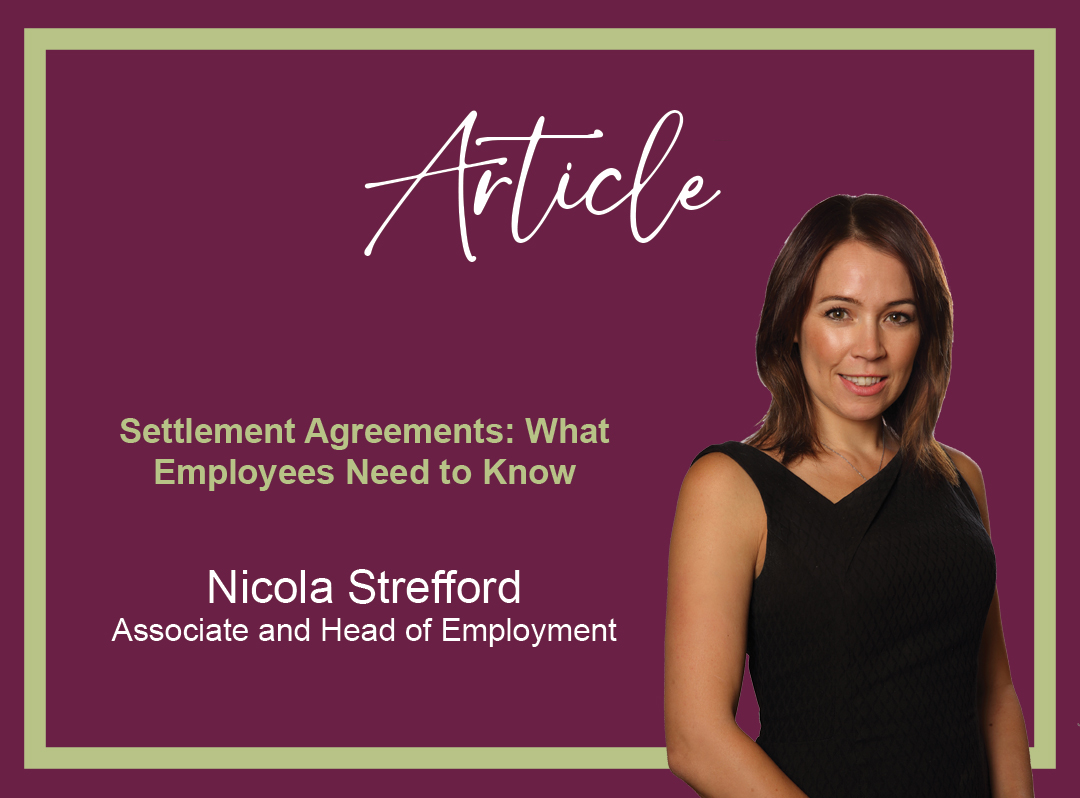
Settlement Agreements: What Employees Need to Know
- Published:
-
Author:
Nicola Strefford
-
Estimated Read Time:
4 minutes
In This Article
Settlement Agreements are very commonly used in terminating someone’s employment or settling a workplace dispute. They provide a timely, certain and pragmatic solution to many employment issues.
What is a Settlement Agreement?
A Settlement Agreement is a legally binding contract between an employer and an employee. They are used to set out the terms on which the employment will end, as well as the rights and duties of both parties.
Settlement agreements tend to include:
Termination date
This will be the exact date upon which your employment will end, and your employment benefits will cease.
An agreed sum to be paid to the employee
This figure often includes PILON (pay in lieu of notice) if you are not required to work during your notice period. You will also receive pay in lieu of any accrued but untaken holiday and any outstanding salary or other contractual entitlements you are owed. These payments will be taxable in the normal way.
It is common for employers to also make compensation payments in settlement agreements. Up to £30,000 of these compensation payments may be paid tax free - provided this represents genuine compensation for loss of employment. If the compensation sum is greater than £30,000, the excess will be subject to tax as normal.
Waiver of the right to bring claims
Settlement Agreements include a waiver of specified claims, meaning you cannot bring those particular claims in the future.
Confidentiality clauses
These clauses outline if, when or to whom you can speak about the settlement agreement, its contents or the events leading up to the agreement.
Restrictive covenants
These are post-termination restrictions put in place to protect your employer’s legitimate business concerns. They may limit your ability to work for a competitor for a specific period of time and prevent any actions which may damage their business relationships, such as soliciting clients, customers or colleagues.
Why do I need legal advice for a Settlement Agreement?
For a Settlement Agreement to be legally binding, the employee must receive independent legal advice from a qualified adviser. Without this advice, the settlement agreement will not be effective to waive statutory claims. It is very important to seek legal advice when entering into these agreements so that, if the need arises, you can enforce your rights.
If either party breaches the terms of the settlement agreement, it could lead to legal action, and it could potentially result in a breach of contract claim in the civil courts.
Most Settlement Agreements include a clause which requires the employee to waive any claims they may have against their employer. It is therefore essential for an employee to meet with an employment law solicitor to understand what potential claims they could be giving up, as well as their legal rights and obligations arising from the settlement agreement.
Do I have to pay for the legal advice?
Employers will usually contribute to the cost of legal advice, often by way of a fixed fee contribution.
Can I negotiate the terms of the agreement?
Yes, most of the terms can be negotiated. Your legal adviser can negotiate with your employer on your behalf and propose reasonable changes. Many Settlement Agreements are drafted multiple times before a final agreement is reached.
How our employment law solicitors can help
We have a specialist and highly experienced employment team who can provide detailed legal advice on your settlement agreement and assist you in negotiating the best outcome.
Offices:
Norwich — 01603 693500
Sheringham — 01263 823398
North Walsham — 01692 660230
Email: enquiries@clapham-collinge.co.uk
The information in this article is for general guidance only and should not be treated as legal advice. It is not a substitute for obtaining advice tailored to your circumstances. While we aim to ensure accuracy at the time of publication, laws and guidance may change. Clapham & Collinge LLP accepts no liability for any loss arising from reliance on this content. For personalised advice, please contact our client relations team to book an appointment.